Sunny Acres Resident Case Study
March 2026
After a pelvic fracture from a fall on ice, Virginia C. rebuilt strength, mobility, and everyday independence through short-term rehab at Sunny Acres.
Summary
Virginia C., 74, came to Sunny Acres Nursing and Rehabilitation Center after a brief hospital stay for a pelvic fracture caused by a fall on ice. Her orthopedic team recommended non-surgical management, pain control, and weight bearing as tolerated on both legs.
When she arrived, pain was limiting nearly every movement. She needed hands-on help for bed mobility, transfers, toileting, lower-body dressing, and walking. With physical and occupational therapy 5–6 days per week, she made steady progress over a 22-day short-term rehab stay.
At discharge, Virginia returned home able to walk more than 300 feet with a rolling walker, manage a full flight of stairs with bilateral rails, and complete daily self-care at modified independent level, meaning she no longer needed hands-on help for most routine tasks, though she could still benefit from extra time, setup, or equipment as needed.
Key Points
- Pelvic fracture after a fall on ice
- Non-surgical treatment with pain management and weight bearing as tolerated
- Arrived needing moderate to maximum help for transfers, bed mobility, toileting, and lower-body self-care
- Could take only 1–2 steps with a rolling walker because of pain at admission
- Participated in PT and OT 5–6 days per week
- Returned home after 22 days
- Walking 300+ feet with a rolling walker at discharge
- Able to manage one full flight of stairs with bilateral rails
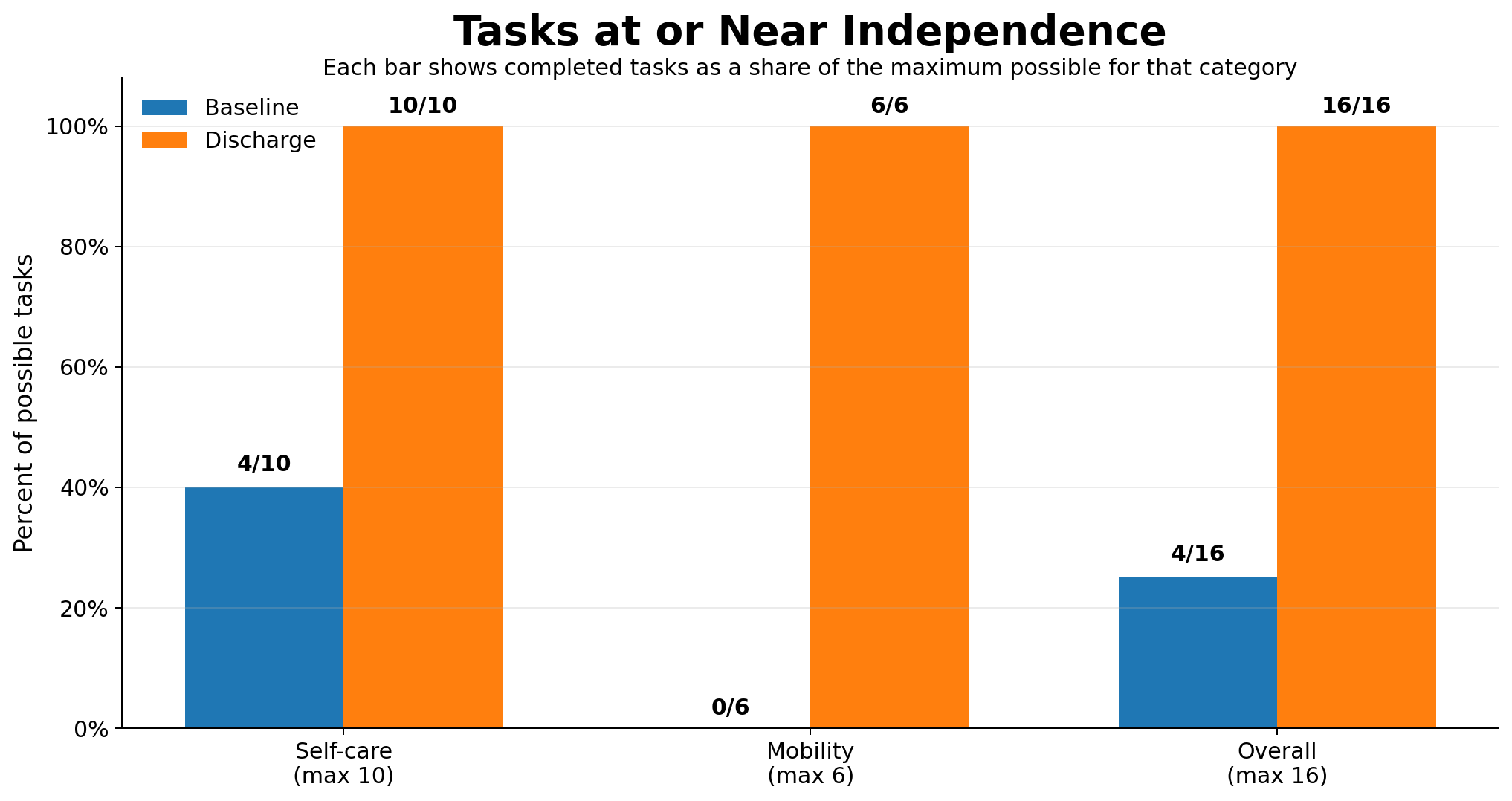
- Improved from 4 of 16 tasks at or near independence to 16 of 16
What brought Virginia to rehab
Virginia was admitted from the hospital after a fall on ice resulted in a comminuted fracture of the right superior and inferior pubic rami. Because the injury was treated without surgery, rehab focused on safe movement, pain-aware mobility, and helping her return home as close as possible to her prior level of independence.
Where she started
At admission, Virginia’s pain made it difficult to shift weight, stand, and walk safely. She needed moderate to maximum assistance for bed mobility and sit-to-stand transfers, and she could manage only 1–2 steps with a rolling walker and moderate assistance.
Her biggest self-care barriers were lower-body dressing, toileting, and bathing-related tasks. These limitations made a home discharge unrealistic without short-term rehabilitation first.
What therapy worked on
Her rehab plan combined physical and occupational therapy 5–6 days a week and focused on the skills she would need most at home: transfers, bed mobility, gait training with a rolling walker, stair negotiation, balance, endurance, and daily self-care tasks such as dressing, bathing, and toileting.
Outcome
Over just more than three weeks, Virginia made measurable gains across both self-care and mobility. By discharge, she was able to return home, walk more than 300 feet with a rolling walker, complete a full flight of stairs using bilateral rails, and perform ADLs at modified independent level.
At admission, she was at or near independence in only 4 of 16 scored daily tasks. By discharge, she reached that level in all 16 of 16 tasks measured.